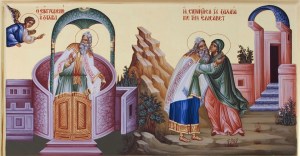
There was in the days of Herod, the king of Judea, a certain priest named Zacharias, of the division of Abijah. His wife was of the daughters of Aaron, and her name was Elizabeth. And they were both righteous before God, walking in all the commandments and ordinances of the Lord blameless. But they had no child, because Elizabeth was barren, and they were both well advanced in years. So it was, that while he was serving as priest before God in the order of his division, according to the custom of the priesthood, his lot fell to burn incense when he went into the temple of the Lord. And the whole multitude of the people was praying outside at the hour of incense. Then an angel of the Lord appeared to him, standing on the right side of the altar of incense. And when Zacharias saw him, he was troubled, and fear fell upon him.
But the angel said to him, “Do not be afraid, Zacharias, for your prayer is heard; and your wife Elizabeth will bear you a son, and you shall call his name John. And you will have joy and gladness, and many will rejoice at his birth. For he will be great in the sight of the Lord, and shall drink neither wine nor strong drink. He will also be filled with the Holy Spirit, even from his mother’s womb. And he will turn many of the children of Israel to the Lord their God. He will also go before Him in the spirit and power of Elijah, ‘to turn the hearts of the fathers to the children,’ and the disobedient to the wisdom of the just, to make ready a people prepared for the Lord.”
And Zacharias said to the angel, “How shall I know this? For I am an old man, and my wife is well advanced in years.”
And the angel answered and said to him, “I am Gabriel, who stands in the presence of God, and was sent to speak to you and bring you these glad tidings. But behold, you will be mute and not able to speak until the day these things take place, because you did not believe my words which will be fulfilled in their own time.”
And the people waited for Zacharias, and marveled that he lingered so long in the temple. But when he came out, he could not speak to them; and they perceived that he had seen a vision in the temple, for he beckoned to them and remained speechless.
(Luke 1: 5-22).
Greatness is by spirituality
For he will be great in the sight of the Lord, and shall drink neither wine nor strong drink. He will also be filled with the Holy Spirit, even from his mother’s womb.”
(Luke 1:15)
“Our life is not estimated according to the time, but according to levels of virtue. For John was called great not because of his physical strength, but because of his spiritual one. He did not overcome empires, neither did he plan on virtues and conquests; he rather looked up to what is by far greater. For he was the voice crying in the wilderness who defeated the physical pleasure, and the bodily lapses in his sublime spirit and its strength. He was small in the worldly matters, yet great in the spiritualities. Finally, the mystery of his greatness is that the love of the temporary life did not overrule him, which did not hinder him from condemning sin.“As an embryo, he lacked the spirit of life, and yet he obtained the spirit of grace. The reality of life is preceded by the grace for sanctification, for the Lord says, (Jer 1: 5) “Before I formed thee in the belly I knew thee; and before thou camest forth out of the womb I sanctified thee, and I ordained thee a prophet unto the nations”. There is a drastic difference between the spirit of the world, and the Spirit of grace. The former begins with birth and ends with death. But latter is unrestricted by time or by years. Death does not extinguish its flame, and the womb of motherhood is not shut upon it. He who possesses the Spirit of grace lacks nothing at all. He who has obtained the Holy Spirit has reached the peak of all virtues.”[St. Ambrose, Commentary on the Gospel of St. Luke]
+ Lord, help me to direct my mind towards You, to reject the pleasures of this world and to live in virtue and holiness as St. John the Baptist did.

 FellowsoftheEleventhHour